

The Most Expensive Parking Ticket Is the One Never Written
Rethink the value of parking enforcement by exploring how better compliance can reduce congestion, improve safety, and prevent wider economic costs.

Why the true value of parking enforcement may be measured in the accidents, delays, and costs that a citation deters.
Imagine a delivery truck double-parked on a busy downtown street during the morning commute.
It probably doesn’t take much to visualize this. It’s something we’ve all unfortunately witnessed.
For fifteen minutes, the truck occupies a travel lane. Motorists slow down, merge into adjacent traffic, and occasionally block an intersection. A transit bus struggles to maneuver around the obstruction. A cyclist moves into traffic to avoid the vehicle. Somewhere farther back, an ambulance approaches, losing critical minutes when the difference between life and death is sometimes mere seconds.
Eventually, the truck leaves.
No citation was issued. There’s no fine to collect. From the perspective of the city's parking enforcement program, nothing happened.
But something did happen.
The obstruction imposed costs on motorists, transit passengers, businesses, and potentially public safety. These costs aren’t abstract. They can be quantified. They simply aren't captured in most cities’ accounting.
What if the greatest economic value of parking enforcement isn't the revenue it generates, but the costs it prevents?
The Economics of a Parking Violation
Municipalities have traditionally evaluated parking enforcement through a relatively narrow set of measures: citations issued, collection rates, revenue generated, and the cost of enforcement personnel and equipment.
These are important metrics. They help manage budgets, evaluate productivity, and ensure accountability.
But they only tell part of the story.
Take, for example, the economic consequences of double parking. A vehicle illegally parked in the travel lane can reduce roadway capacity, delay transit service, increase fuel consumption, exacerbate air pollution, interfere with commercial deliveries, and create dangerous conditions for cyclists and pedestrians.
Economists refer to costs like these as negative externalities. The individual responsible for the violation does not necessarily bear the full cost of the behavior. Instead, those costs are distributed across the broader community.
A parking citation assigns a monetary penalty to the violation. But that penalty should not be confused with the economic harm caused by the underlying behavior.
The two can be very different, and the fine often does not fully compensate for societal loss.
Putting a Price on Lost Time
Fortunately, municipalities don't need to invent an entirely new economic framework to begin understanding these costs.
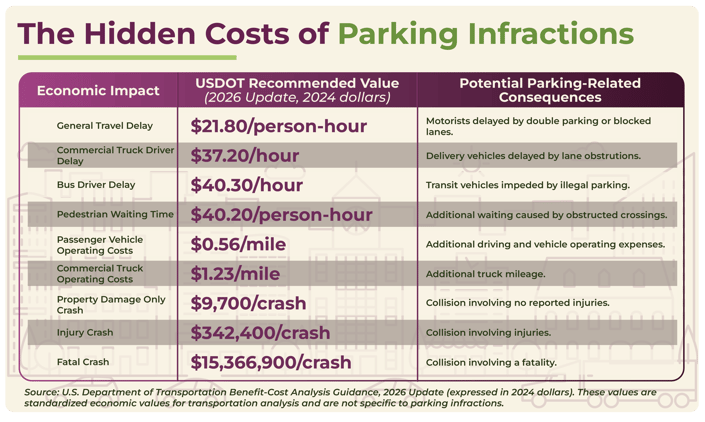
The U.S. Department of Transportation already publishes guidance for evaluating the economic benefits and costs of transportation investments. Its Benefit-Cost Analysis Guidance for Discretionary Grant Programs 2025 and 2026 updates provides methodologies for valuing travel-time savings, vehicle operating costs, safety improvements, and emissions reductions.
Although developed for transportation investment analysis rather than parking enforcement, these methodologies offer a useful starting point for evaluating the consequences of parking-related obstructions.
Consider the above hypothetical fifteen-minute double-parking incident. Suppose it delayed 300 motorists by an average of 45 seconds and a bus carrying 30 passengers by two minutes.
Using USDOT's 2025 general travel-time value of $21.10 per person-hour, those delays represent approximately $100 in lost travel-time value.
That is more than many parking fines, and it excludes additional vehicle operating costs, emissions, and potential safety consequences.
Now imagine twenty comparable incidents occurring each business day over 250 days. Under those illustrative assumptions, the annual economic cost of travel delays alone would exceed $500,000.
These are not measured outcomes or a prediction of actual conditions. The assumptions would need to be validated against traffic volumes, occupancy, fuel prices, and observed delays. But the exercise demonstrates something important: seemingly minor parking violations can impose meaningful costs when their effects are multiplied across an urban transportation network.
However, travel time is only one part of the equation.
When Enforcement Becomes a Safety Strategy
The relationship between parking enforcement and public safety is not always straightforward. A parking citation does not, by itself, prevent a collision. But consistent enforcement can influence behavior, and changes in behavior can affect the safety and efficiency of the transportation network.
New York City's Automated Camera Enforcement (ACE) program offers a compelling example. The Metropolitan Transportation Authority uses cameras mounted on buses to identify vehicles illegally occupying bus lanes, blocking bus stops, or double parking along bus routes. According to the MTA, routes equipped with automated enforcement have experienced average speed improvements of approximately 5%, with gains reaching 30% on some corridors.
More importantly, the agency reports a 20% reduction in bus collisions on ACE-equipped routes and a 40% reduction in blocked bus stops. While a variety of factors may have contributed to these improvements, the data suggest that enforcing existing roadway restrictions can produce benefits extending well beyond citation revenue.
Indianapolis offers a complementary, though more correlative, example. As part of its ParkIndy program, the city introduced a more targeted, data-informed approach to parking enforcement, directing personnel toward locations and periods where violations were more likely to occur.
In 2025, parking citation issuance increased 69% compared with the previous year, without adding enforcement personnel.
Over comparable reporting periods, Indianapolis experienced a 13% reduction in pedestrian and cyclist collisions, from 128 to 111. Serious injuries declined 16%, from 91 to 76, while fatalities decreased 5%, from 37 to 35.
These figures do not establish that increased parking enforcement caused the improvements. Several factors can influence collision rates. Still, the simultaneous increase in targeted enforcement and reduction in collisions is noteworthy. It raises an important question about whether more strategic enforcement can contribute to improved transportation safety.
There is also evidence supporting the safety value of keeping intersections clear. The Federal Highway Administration's pedestrian safety countermeasures research identifies restrictions on parking near intersections as a measure associated with an estimated 30% reduction in crashes under the conditions evaluated. The principle is relatively simple: parked vehicles can obstruct sightlines, limiting the ability of motorists, cyclists, and pedestrians to see one another.
Of course, establishing a parking restriction and ensuring compliance with that restriction are two different things. A clear intersection cannot deliver its intended safety benefits if vehicles routinely occupy prohibited spaces. A dedicated bicycle lane offers diminished protection when cyclists must repeatedly maneuver around illegally parked vehicles. And a bus lane cannot deliver reliable service if unauthorized vehicles regularly obstruct it.
Enforcement is not a substitute for good street design. It is one of the mechanisms through which good street design delivers its intended benefits.
From Citation Productivity to Public Value
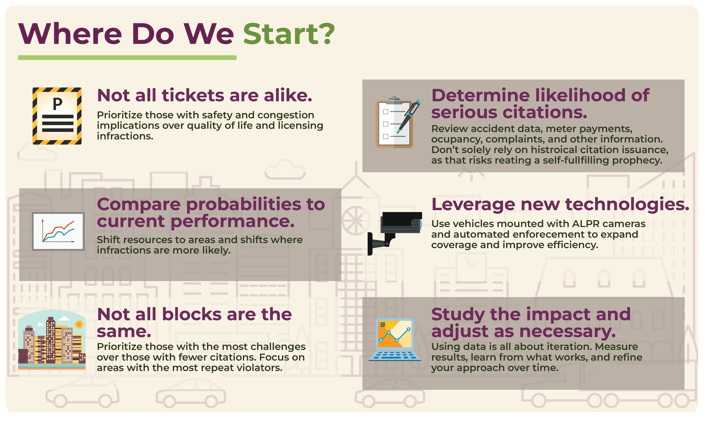
Parking enforcement resources are finite. Cities cannot place an enforcement officer on every block, at every intersection, or beside every bicycle lane. Consequently, enforcement is fundamentally an exercise in optimizing how resources are allocated.
Historically, municipalities have often relied on citation histories, geographic assignments, complaints, and officer experience to determine where enforcement personnel should work. These approaches have value, but they may overlook an important distinction between the frequency of violations and the harm those violations cause.
A location generating numerous relatively minor parking violations may produce substantial citation revenue. Another location might generate fewer violations but experience repeated transit obstructions or dangerous conflicts involving cyclists and pedestrians.
Which location deserves greater enforcement attention? If the objective is maximizing citations, the answer may be straightforward. If the objective is maximizing public value, the answer becomes more interesting. A more sophisticated approach would consider not only the likelihood of noncompliance, but also its consequences.
Cities like Chicago combine parking violation histories with collision data, meter payments, time-of-day patterns, and 911/311 complaints. It’s possible that factors like traffic volumes, transit performance, bicycle infrastructure, and land use can offer a window into where compliance is most beneficial to the community.
This isn’t about increasing enforcement indiscriminately. Nor is it about maximizing penalties. This is an argument for directing limited public resources toward the problems that matter most.
The Paradox of Successful Enforcement
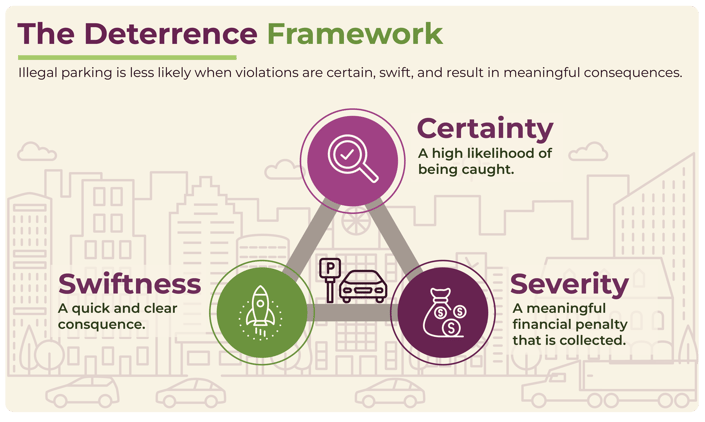
Effective deterrence depends on more than the likelihood of receiving a citation. Timely enforcement, prompt notification, and consistent consequences strengthen the connection between a violation and its outcome, encouraging motorists to change their behavior. The objective is not simply to collect revenue, but to create a credible expectation of accountability that improves compliance.
And that creates a paradox. As compliance improves, violations should decline, potentially resulting in fewer citations and less revenue. Under traditional financial measures, a successful enforcement program could therefore appear less productive, even as it delivers greater public value through reduced congestion, improved mobility, safer streets, and more reliable transit.
Enforcement is a means to an end. Compliance is the desired behavioral outcome. The public benefits resulting from that compliance are the ultimate objective.
Measuring What Doesn't Happen
The challenge, of course, is that prevention is difficult to measure.
A citation appears in a database. A payment appears in a financial report. The costs of an obstruction that was mitigated doesn’t appear anywhere. But that does not make those benefits unknowable.
Advances in data analytics, predictive modeling, and operational measurement increasingly allow municipalities to estimate the effects of enforcement strategies and compare outcomes across locations and time periods. The key is to establish credible baselines, measure changes in compliance and transportation performance, and distinguish improvements attributable to enforcement from changes caused by other factors.
Infraction mitigation analysis is not a perfect science. And that’s fine if it is transparent, disciplined, and grounded in evidence. And municipal leadership is willing to change its perspective.
Instead of just asking only how many citations an officer issued, municipalities might also ask how much harmful noncompliance was prevented.
Instead of evaluating enforcement solely through revenue and operating costs, they might consider its contribution to mobility, safety, and economic efficiency.
And instead of deploying resources primarily where violations are easiest to find, they might, like Chicago, prioritize locations where improved compliance creates the greatest public benefit.
Ultimately, municipal leaders should consider three distinct measures of success:
The most successful parking enforcement program may not be the one that issues the most citations or collects the most revenue. Rather, it may be the one that prevents the greatest amount of harm. Because the true value of enforcement isn't necessarily reflected in the revenue it generates. It's reflected in the costs it prevents.
Turning Enforcement Data into Public Value
At Trellint, we help municipalities look beyond traditional enforcement metrics to understand where limited resources can make the greatest difference. By combining data analytics, predictive modeling, and operational expertise, we help cities develop smarter enforcement strategies that improve compliance, support safer streets, and deliver measurable public value. If your community is ready to rethink how it measures and manages parking enforcement, we'd welcome the opportunity to start a conversation. Contact Trellint to explore what's possible.
Sources
FHWA Pedestrian Countermeasures
.
Read the newest updates and insights from our team.
Rethink the value of parking enforcement by exploring how better compliance can reduce congestion, improve safety, and prevent wider economic costs.

As parking technology matures, feature lists matter less than architecture. Here's what agencies should really evaluate when choosing their next platform.

As AI adoption grows across the parking industry, Gaurav Khanna from Trellint explores why success depends on building an AI-ready organization.
Discover key takeaways from Trellint's IPMI Virtual Learning Lab, where David Strathy-Miller and Sean Mackin discuss open ecosystems, modernization, and future-ready parking technology.

Evaluate parking citation collections bids with confidence. A practical guide to RFP requirements, vendor accountability, performance oversight, and revenue recovery.
Discover how predictive modeling, forecasting, and independent analysis help cities improve parking collections performance and revenue outcomes.
Have a question or request? Let us know and we’ll follow up shortly.