

AI-Ready, Not Just AI-Enabled: What Parking Leaders Need to Know
As AI adoption grows across the parking industry, Gaurav Khanna from Trellint explores why success depends on building an AI-ready organization.

Artificial intelligence has moved quickly from emerging technology to a practical business tool. According to a survey by Gallup, AI use in the public sector continues to rise. In Q4 2025, 43% of employees reported using AI at least occasionally, including 21% who used it frequently.
As adoption grows, I keep seeing the same question come up: “Which AI tool should we use?”
On the surface, it sounds like the right question. I believe a more important one exists.
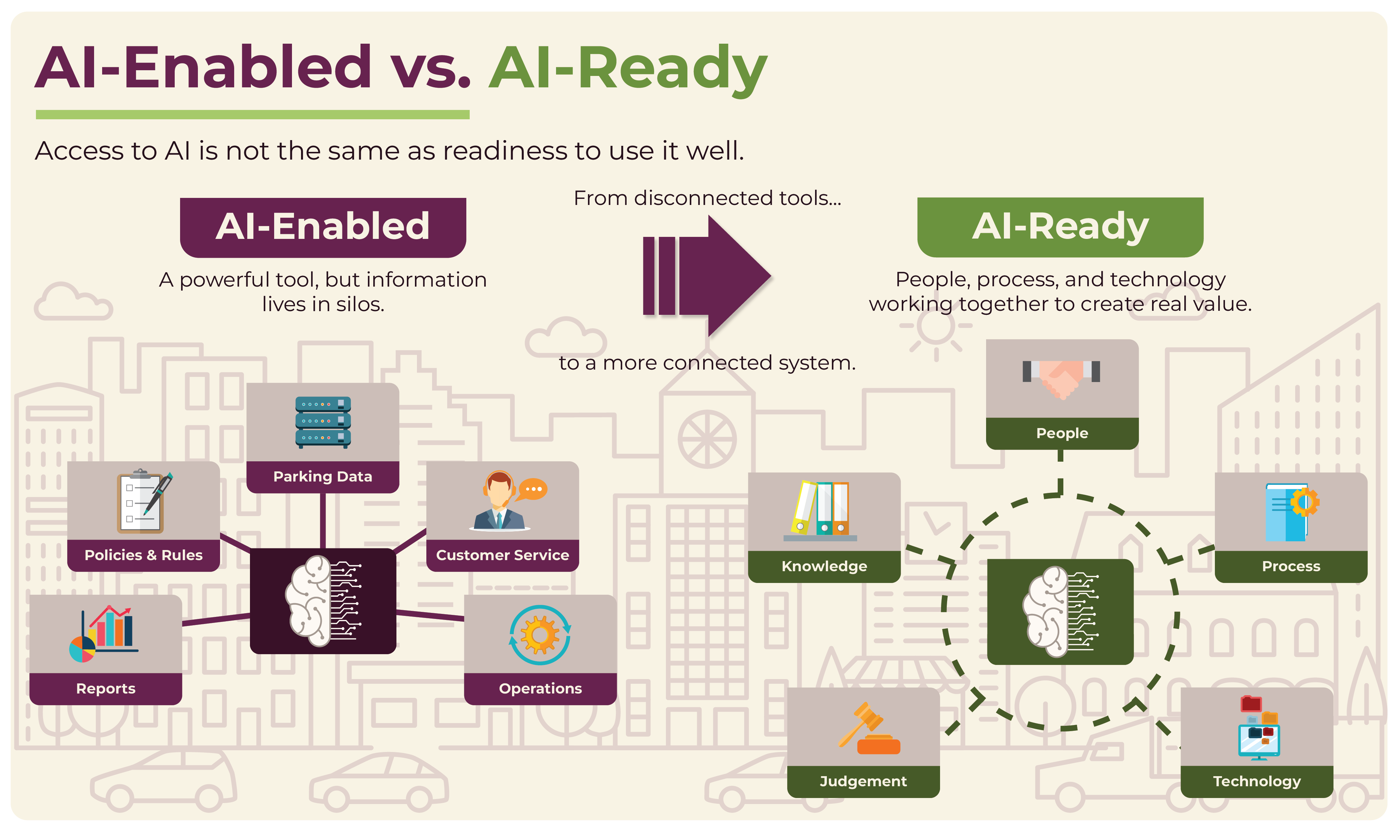
The more important question is whether the organization is ready to use AI effectively. Tools matter, but AI readiness is ultimately a people and operating-model problem. Without the right foundations in place, even the best technology can deliver very little value.
Most parking organizations are not exploring AI because they want another piece of technology. They are trying to solve operating problems.
Think about how much time teams can spend on work such as:
Individually, these may look like small inefficiencies. Across a team, a department, or an entire operation, they can add up. That is why I believe the right place to start is not with a broad AI initiative. Start by understanding where people are losing time today, where information is difficult to find, and where better thinking or faster access to knowledge would materially improve the work.
Parking organizations already have a tremendous amount of information.
Therefore, the challenge is often not whether the information exists. The challenge is finding the right information, with the right context, when someone needs it.
That is an area where AI can be impactful. It can help employees locate relevant information, summarize large bodies of content, identify patterns, draft communications, and bring together context that may otherwise be spread across different systems and teams.
But there is an important distinction: AI should not become a shortcut around understanding the work. It should help people access information faster, so they can focus on analysis and strategy rather than sifting through large amounts of information.
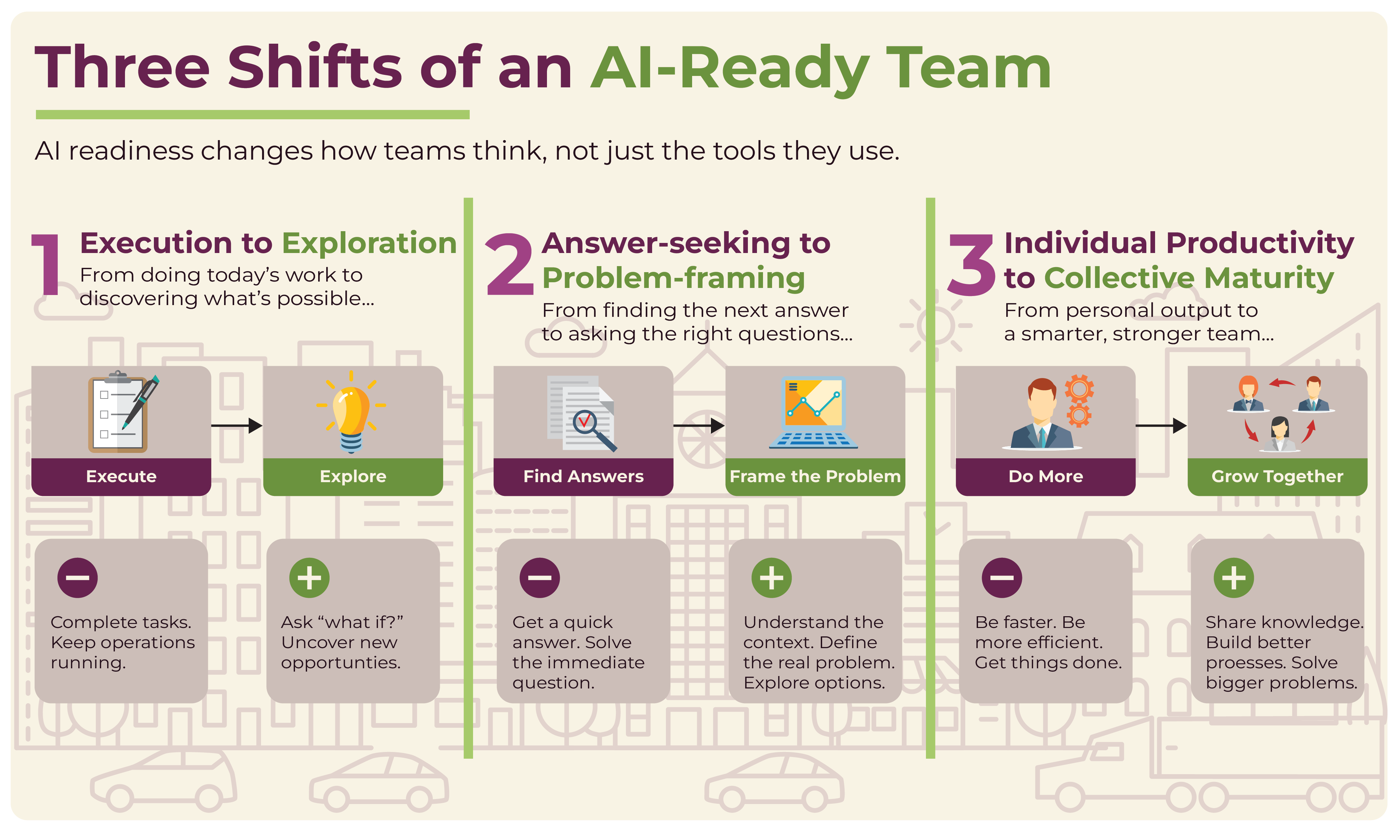
For me, AI readiness shows up in how people think and work, not in how many tools they have access to. I see three shifts that matter:
1. From execution to exploration
Most teams are trained to execute. They take a requirement, follow a process, complete the task, and move on.
AI changes that dynamic. It gives employees a low-cost way to explore alternatives, test assumptions, compare approaches, and ask, "What else should I be considering?" before committing to an answer. That ability to experiment makes it easier to challenge established ways of working and uncover new opportunities for improvement. It also encourages teams to spend more time evaluating options rather than simply moving to the first available solution.
AI amplifies curiosity. If curiosity is missing, there is much less for AI to amplify.
2. From answer-seeking to problem-framing
Weak AI usage is usually a request for an answer. Strong AI usage starts with understanding the problem, including the context, constraints, trade-offs, and desired outcome.
In parking, that distinction matters. Permit rules, enforcement scenarios, customer communications, and operational reports often carry policy, contractual, and community implications. The quality of the outcome depends heavily on how well the problem is framed.
I think of AI less as a solution engine and more as a thinking partner but people are still responsible for applying judgment, weighing trade-offs, and making decisions. The most successful organizations will use AI to support decision-making, not replace it.
3. From individual productivity to collective maturity
Many teams begin by treating AI as an individual productivity tool.
That is natural, but the larger gains come when useful practices are shared. A successful prompt, workflow, or reference document should not stay with the person who created it. One person's experiment can become a team workflow.
Over time, those shared practices create consistency in how teams approach problems and use AI. They also reduce the need for individuals to reinvent solutions that already exist elsewhere in the organization.
One of the most practical ways to build AI readiness is to start with a specific workflow rather than an organization-wide transformation program.
For a parking organization, that might mean using AI to answer recurring customer enquiries, summarize permit policies, draft routine communications, analyze operational reports, or help employees find information spread across multiple systems.
The key is to start with a problem that is meaningful enough to demonstrate value but focused enough to learn from. We are already seeing examples of this within our teams. One colleague has built customized Jira dashboards that streamline daily Scrum management. Another has developed an application monitoring suite that provides a single view of the health of every application instance they support.
These initiatives deliver immediate operational value while remaining close to the individual's day-to-day responsibilities. More importantly, they give teams a practical way to build confidence with AI in a low-risk environment. Successes that people can see and experience firsthand are often what encourage broader adoption across an organization.
That is how confidence grows: not through theory, but through improvements that people can see in their own work.
AI capabilities will increasingly become standard features inside the software organizations already use. As that happens, access to AI will stop being much of a differentiator.
The differentiator will be how well organizations use it.
Organizations that successfully integrate AI into everyday operations will make decisions faster, respond more effectively to changing demands, and get more value from the information they already have.
For parking leaders, that means the AI conversation should extend beyond software features and product demonstrations. The more important conversation is whether the organization is prepared to turn those capabilities into meaningful operational outcomes for employees, customers, and the communities they serve.
So, before asking, “Which AI technology should we adopt?” I would ask a different question: Because access to AI will increasingly become common. The ability to use it thoughtfully, responsibly, and effectively will not.
That is the difference between being AI-enabled and being AI-ready.
Read the newest updates and insights from our team.
As AI adoption grows across the parking industry, Gaurav Khanna from Trellint explores why success depends on building an AI-ready organization.

Discover key takeaways from Trellint's IPMI Virtual Learning Lab, where David Strathy-Miller and Sean Mackin discuss open ecosystems, modernization, and future-ready parking technology.

Evaluate parking citation collections bids with confidence. A practical guide to RFP requirements, vendor accountability, performance oversight, and revenue recovery.
Discover how predictive modeling, forecasting, and independent analysis help cities improve parking collections performance and revenue outcomes.
Discover how to manage a flexible, integrated ecosystem that delivers safer streets, better mobility, and long-term value.

Parking enforcement is more than issuing tickets. Discover how data-driven programs improve safety, fairness, and outcomes across cities.
Have a question or request? Let us know and we’ll follow up shortly.