

Beyond the Feature List: What Public-Sector Parking Buyers Should Evaluate Now
As parking technology matures, feature lists matter less than architecture. Here's what agencies should really evaluate when choosing their next platform.
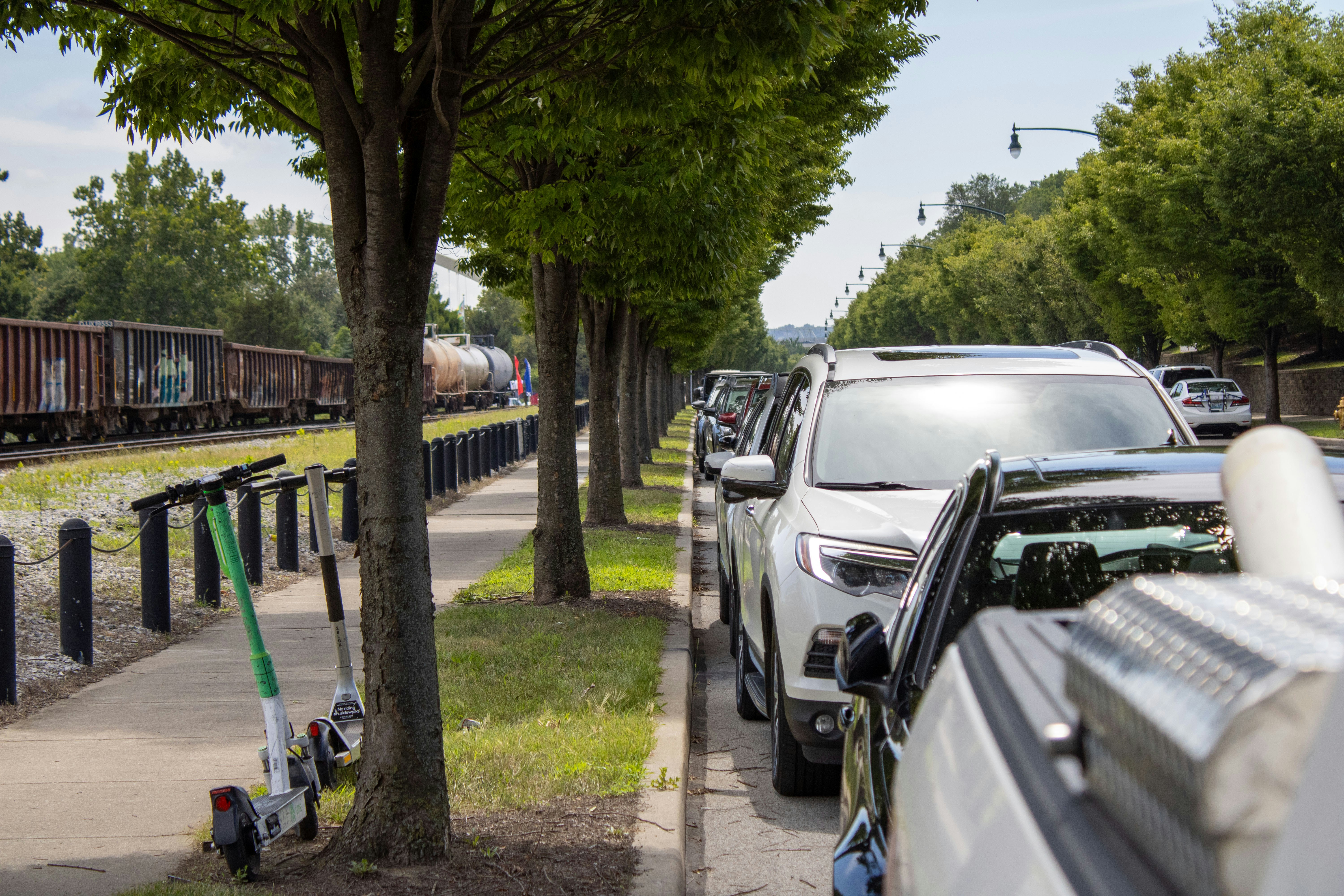
Cities are not buying meters, sensors, apps, camera systems, or citation tools because they’re passionate about the tools themselves.
They invest because of what those tools can enable.
Safer streets. Less congestion. Fairer access. Sustainable funding for city services.
That’s what really matters.
The challenge is that these outcomes are rarely delivered by a single solution.
They come together over time, shaped by ecosystems.
Why Ecosystems Matter
In nature, healthy ecosystems produce benefits far beyond the organisms that inhabit them.
Forests clean the air. Wetlands reduce flooding. Pollinators support food production. Healthy ecosystems create value not because any one species dominates, but because many specialized organisms interact in ways that support the broader environment.
The curb functions the same way. A healthy parking ecosystem creates benefits that extend far beyond parking itself. When the ecosystem functions properly:
These outcomes do not emerge from a single vendor, technology, or platform. They come from many different tools like meters, payment apps, enforcement software, cameras, sensors, wayfinding apps, EV charging, reservations, and more.
Together, these technologies form an ecosystem.
The Value of Specialization
Every healthy ecosystem relies on specialists. Nature does not have a single organism that performs every function.
Bees pollinate. Predators control populations. Trees create habitat. Fungi recycle nutrients.
The parking ecosystem functions the same way. Meter manufacturers specialize in monetizing parking spaces. Wayfinding providers specialize in helping drivers navigate available parking. Payment providers specialize in transactions. Camera vendors specialize in image capture. Sensor companies specialize in occupancy detection.
These specialists create value because they solve specific problems exceptionally well.
But specialization itself does not create an ecosystem. Coordination does. As ecosystems grow, cities must manage more vendors, integrations, contracts, data flows, and competing priorities.
That complexity has fueled the rise of a very different model: vertically owned technology stacks.
The Rise of Vertically Owned Technology
Over the past decade, the parking industry has experienced significant consolidation. Companies that once specialized in a single function have been acquired and integrated into larger platforms, merging meters with wayfinding with payment apps with sensors with enforcement.
From the outside, it’s a compelling promise: one vendor, a single contract, and the potential for efficiency.
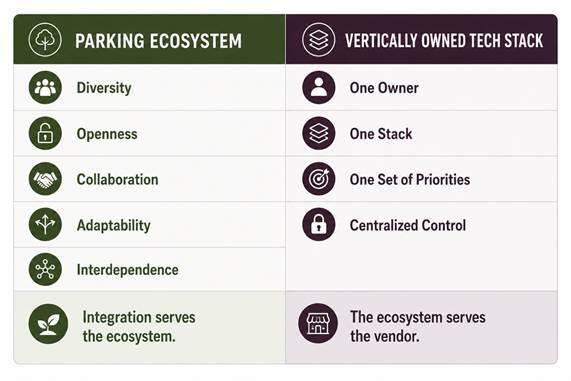
But there is an important distinction between an ecosystem and a vertically owned platform. An ecosystem is governed by interactions among many participants. A platform is governed by the priorities of its owner.
When Platform Objectives Become City Objectives
Cities optimize for public outcomes: safety, mobility, equity, affordability, and efficient use of public resources.
Vertically owned companies optimize for something entirely different: transactions, adoption, and revenue. Occasionally these objectives overlap. But that overlap is not natural.
Consider the case of occupancy data. A city may use occupancy information to adjust meter prices to improve turnover, reduce circling behavior, and better manage congestion.
A vertically owned company may use the same information to drive enforcement to increase payment transactions. They don’t have an interest in meter rate increases that reduce parking demand, payment transactions, and revenue.
Over time, these different objectives compound, and cities may find themselves optimizing the vertical platform rather than optimizing the curb.
The Risk of Ecosystem Collapse
Healthy ecosystems thrive because they maintain diversity. No single species controls everything. No single failure collapses the entire system. Competition encourages adaptation. Open interaction encourages innovation.
The same principles apply to parking technology. When cities become overly dependent on a single provider, they risk losing flexibility. They lose transparency. Replacing underperforming components becomes more difficult. New technologies become harder to introduce. Procurement options narrow. Vendor lock-in increases.
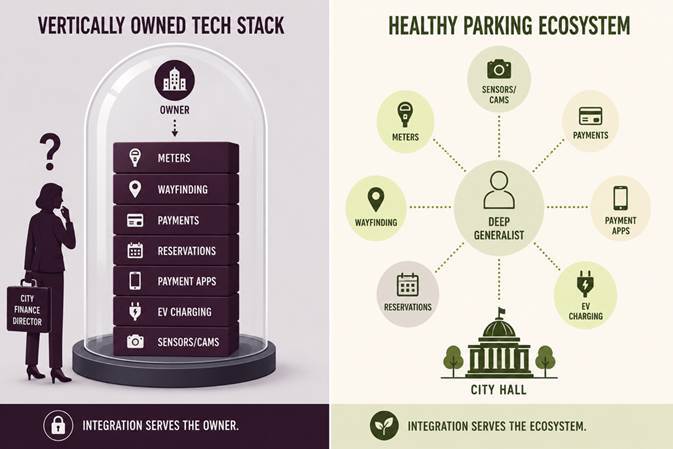
This dynamic can also weaken support for third party integration and interoperability standards. Specialist integration is critical. Like ecological diversity in nature, integrating with specialists promotes resilience. Integrating with a variety of specialists allows technologies to interact without requiring a single owner, preserving flexibility, encouraging innovation, and delivering on city objectives.
Agnostic integration ensures the ecosystem serves the city, not vertically owned platforms.
Enter the Deep Generalist
This is where the deep generalist becomes essential. The deep generalist is not a specialist. They’re not an expert on sensors, payment apps, or enforcement platforms. Rather, the deep generalist understands how those disciplines interact.
In ecological terms, specialists study species. The deep generalist studies the ecosystem. They understand how parking policy influences enforcement, and enforcement influence turnover, and turnover influences congestion, and congestion impacts safety, and safety influences bike ridership…and how all these things impact revenue.
Stewarding the Parking Ecosystem
The future of curb management will not be determined by who owns the most technology. It will be determined by who best aligns technology with public outcomes.
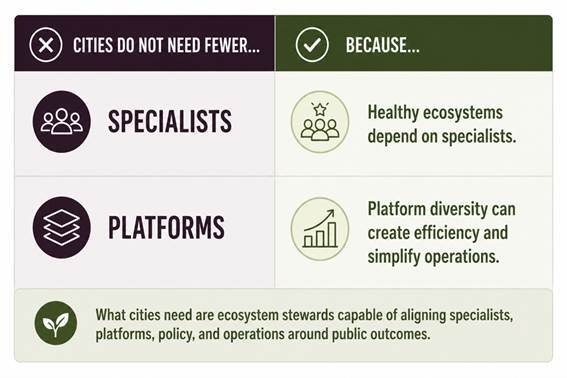
What cities need are stewards. People capable of understanding the interactions between parking technology, policy, operations, finance, enforcement, equity, and mobility.
People willing to ask difficult questions and to challenge vendors, assumptions, and technologies when they are no longer serving the public interest.
In short, cities need parking ecosystem managers. They need deep generalists.
Because the goal should not be to optimize for the vertically owned tech stack. The goal must be to optimize the curb ecosystem to drive safer streets, faster travel, stronger communities, and better outcomes for everyone who depends on the curb.
Who is stewarding your parking ecosystem?
Specialist providers optimize individual parking technologies. Vertically owned companies optimize for their tech stack.
We optimize the parking ecosystem.
Cities need someone focused on something bigger: ensuring that specialists, platforms, policy, operations, and public goals work together to produce better outcomes.
That's the role Trellint plays. We help cities align complex parking ecosystems around what matters most: your city goals of safety, mobility, equity, operational performance, and fiscal sustainability.
If you would like to explore this topic further, please get in touch and one of our team will reach out.
Read the newest updates and insights from our team.
As parking technology matures, feature lists matter less than architecture. Here's what agencies should really evaluate when choosing their next platform.

As AI adoption grows across the parking industry, Gaurav Khanna from Trellint explores why success depends on building an AI-ready organization.

Discover key takeaways from Trellint's IPMI Virtual Learning Lab, where David Strathy-Miller and Sean Mackin discuss open ecosystems, modernization, and future-ready parking technology.
Evaluate parking citation collections bids with confidence. A practical guide to RFP requirements, vendor accountability, performance oversight, and revenue recovery.
Discover how predictive modeling, forecasting, and independent analysis help cities improve parking collections performance and revenue outcomes.
Discover how to manage a flexible, integrated ecosystem that delivers safer streets, better mobility, and long-term value.
Have a question or request? Let us know and we’ll follow up shortly.