

Beyond the Feature List: What Public-Sector Parking Buyers Should Evaluate Now
As parking technology matures, feature lists matter less than architecture. Here's what agencies should really evaluate when choosing their next platform.

Job satisfaction is not just about doing the work. It is about impact, the sense that what you do every day makes a difference beyond your organization.
When that connection is clear, people perform differently. They make better decisions, stay engaged, and find meaning even in routine work. When it is not, the work starts to feel mechanical.
Nowhere is that disconnect more visible than in parking enforcement.
The public rarely experiences enforcement as a service. A ticket feels like punishment. A notice feels like a threat. The people behind the system absorb that perception every day, often without a clear counterpoint that explains what the work is achieving.
But when a program is designed well, the outcomes are significant. The analyst refining a collections model, the ambassador issuing citations near a school, the project manager implementing new systems, and the director shaping policy are not just maintaining operations. They are contributing to safer streets, fairer systems, and cities that function more predictably.
That only holds if the program is designed to produce those outcomes. And only if those outcomes are clearly defined.
Without that clarity, the work narrows. Daily pressures fill the space. Reports, complaints, escalations, and budgets take priority. The system keeps running, but the purpose fades into the background.
The corrective is simple but rarely applied. Step back and ask: what changed? Who is better off because this program worked the way it should?
Every program needs a clear answer to a more fundamental question: if enforcement is working as it should, what does the city look like?
How cities should operate
A city where every inch of public space works for the people who need it, when they need it.
Where transit is not blocked. Accessible spaces remain available. Loading zones work during delivery windows. Emergency access is never obstructed.
Where enforcement is consistent. Every violation is detected. Every rule is applied the same way. No neighborhood is left questioning whether enforcement is uneven.
Where consequences follow quickly. Citations are processed, notices are delivered, and collections begin on a timeline that drives compliance.
Where fine levels reflect real impact. Serious violations are high enough to deter behavior that creates risk. Lower-level infractions remain proportionate and payable.
Where every interaction generates insight. Citations, hearings, and collections activity feed a system that improves over time.
And where the people running the program can point to a result and say: that is better because of what we did.
The stakes are not abstract:
These are not edge cases. They are the predictable outcomes of poorly managed parking. They are also what good programs prevent.
Without a clear north star, parking programs drift.
The system keeps running. Notices go out. Citations are issued. Vendors report. Revenue lands on a spreadsheet. But the deeper question is never asked.
The work becomes self-justifying. Volume replaces outcomes. And the people running the system start to feel like they are maintaining machinery instead of serving a city.
The gap between most programs and what is possible is not a technology problem. It is a data problem. The inputs already exist. They are just not being connected.
Why most programs drift
Most parking programs were not designed to be optimized. They were assembled over time:
None of this is intentional. It is inertia.
Programs are administered instead of actively managed. Over time, that compounds. In a system that touches hundreds of thousands of people, small inefficiencies become systemic failures.
The result is predictable. Enforcement concentrates in the same places. Fines disconnect from deterrence. Collections become a back-office function instead of a compliance tool.
The difference is simple. Better programs ask better questions.
What Becomes Possible When You Ask Questions
The Question in Indianapolis: Are enforcement schedules aligned with the need for enforcement?
In Indianapolis, Trellint worked with ParkIndy to rebuild enforcement deployment around data. The inputs were not traditional, but not so exotic: meter transaction records showing where and when compliance was weakest, community complaint patterns, crash pedestrians and cyclist collisions, and historical issuance.
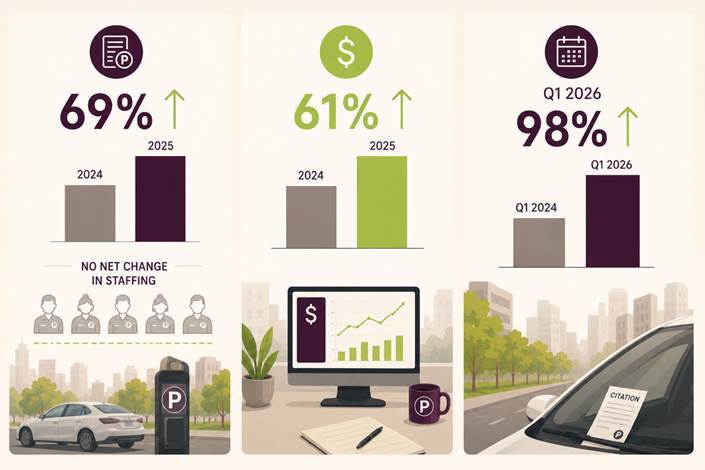
The result was predictive scheduling: officers deployed where the data said compliance pressure was needed most. Citation volume grew 69% year-over-year with no net change in staffing. Citation revenue improved 61%. In Q1 2026, citation issuance increased further: 98%.
But the safety numbers are at the front of this conversation. In the same period, pedestrian and cyclist collisions fell from 128 to 111, a 13% reduction. Serious injuries dropped from 91 to 76, a 16% decline. Fatalities fell from 37 to 35.
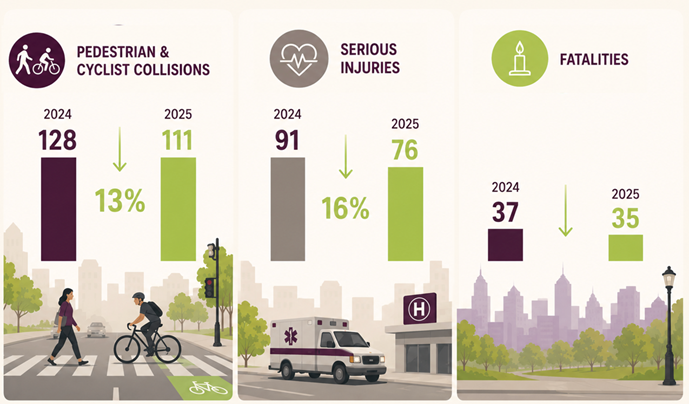
Those are not coincidental. Enforcement deployed consistently near crash-prone intersections, school zones, and high-complaint corridors does not just generate citations; it changes driver behavior. Deterrence, not citation volume, is the actual goal of a compliance program. Indianapolis demonstrated that when you align enforcement with where safety risk is concentrated, the program produces both outcomes simultaneously.
The Question in Chicago: Can enforcement be allocated in a way that’s fair and targets the most serious infractions?
Trellint's analysis of citation patterns across Chicago aligned with the findings of investigative journalists; both the share of tickets issued, and the average fine amounts were higher in disadvantaged communities than in wealthier neighborhoods.
We worked with the city to map the likelihood of infractions by hour and day using regulatory data, street cleaning schedules, meter use, 911 and 311 parking complaints, and historical issuance. By reexamining the size and shape of enforcement zones based on citation probabilities and road miles and giving weight to violations most likely to impact health, safety, and congestion, Trellint was able to suggest new enforcement zones and assignments. This realignment led to a reduction in the amounts due and share of citations issued in disadvantaged communities.
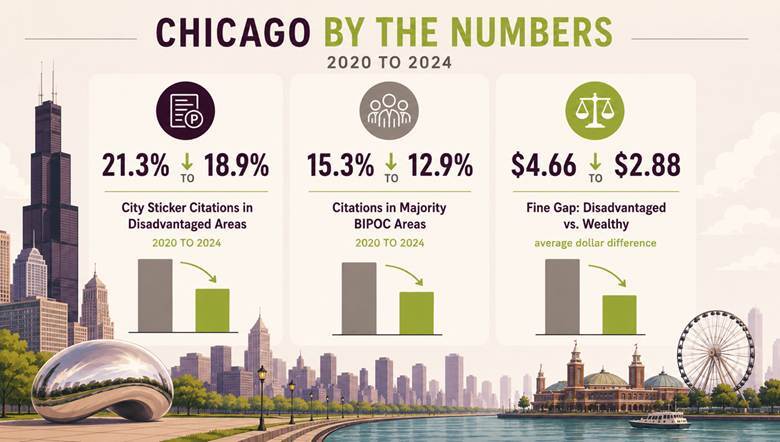
The same logic applied to booting. Chicago boots approximately 50,000 vehicles per year for outstanding debt. Without data, booters deployed based on assumption. Unfortunately, those assumptions tended to fall disproportionately in communities where access to a car is not a convenience but a necessity.
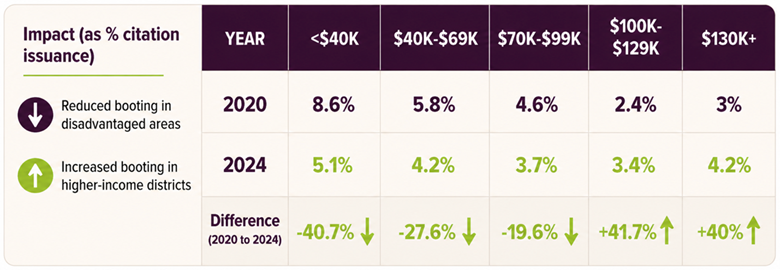
Trellint predicted the locations of boot-eligible motorists across the city, applying a hardship scale that shifted resources toward business districts with more transient curb use, where boot-eligible vehicles are more concentrated and generally accumulate more tickets, and away from households more likely to depend on that car to function.
Since the implementation, booter productivity increased 13%. As a percentage of tickets issued, booting declined significantly in households earning the least, those making less than $40K and between $40K-$69K, but increased dramatically in wealthier neighborhoods.
The Question in Los Angeles: What do fairer fines that promote compliance look like?
Ask a city manager when their fine schedule was last reviewed using data. In most jurisdictions, the honest answer is never, or not in recent memory.
The assumption behind most fine schedules is intuitive: higher fines mean more deterrence and more revenue. However, the data tells a more complicated story.
When fines are disproportionate to the offence, collectability drops. A motorist with an expired plate isn’t a safety risk and is less likely to pay a high penalty. The fine fails to drive behavior change. Conversely, when fines are too low for serious violations, for example double parking or blocking a fire hydrant, the calculus for a driver risking a ticket doesn’t change.
Trellint's data modeling in Los Angeles examined fine levels against actual social harm, the real cost of each violation type in safety, access, and congestion, and recommended adjustments in both directions. The projected result was more than $9 million in additional revenue over five years. The mechanism was not extracting more money from existing accounts. It was improving collection rates by aligning fine amounts with what motorists would pay, while increasing deterrence on violations that matter most.
The Question: What happens when we rethink how we collect tickets?
Collections is not separate from compliance. It is the mechanism by which compliance is enforced on the population that does not comply voluntarily. And its design determines whether your enforcement program deters illegal parking or not.
Deterrence is shaped by three factors: certainty of being cited, severity of consequence, and the speed of response. When citations sit unresolved for months, deterrence weakens. Without a timely consequence, non-compliant motorists do not experience an immediate impact.
A program designed around speed and certainty works differently. Those that perform best factor:
Collections programs are not about harshness. They’re about credibility.
But collections programs must be managed, not just contracted. This requires continuous benchmarking of vendor performance and portfolio allocation governed for recovery outcomes.
Active management of exactly this kind produced $4.05 million in measurable revenue improvement for a court fine program. The money was already in the portfolio. What changed was the management discipline applied to recovering it.
The Question: Are the scales of justice balanced?
One of Trellint's client findings deserves more attention: affluent motorists were nearly four times more likely to contest citations in writing than low-income motorists. And when they did, they were much more likely to be found “not liable.”
That gap, we found, tied to literacy rates and access, the knowledge of how to navigate the process, the time to do it, and the confidence that engagement will produce a fair result. The consequence is asymmetric: the people most likely to be harmed by an unjust citation are the least likely to challenge it.
A hearings process that produces systematically different outcomes by income level is not adjudicating citations. It is laundering inequity through a procedural formality. The fix is accessible design: plain-language notices that explain the right to contest and how to exercise it, online options that don't require time off work, and outcome data monitored regularly for disparities. None of this is complicated. All of it is achievable.
The Question: Are our parking meters priced right?
Congestion is a parking problem as much as a traffic problem. Studies consistently show that a significant share of urban traffic is not through-traffic. Rather, it is drivers circling for parking. In downtown Los Angeles, that dynamic was measurable and chronic: motorists endlessly looping city blocks searching for spaces near their destinations, adding to congestion, pollution, and travel times that affected everyone on the road.
Trellint's partnership with LADOT through the LA Express Park program addressed this at the source. Rather than building more parking or adding enforcement officers, the program used demand-based pricing to align the cost of parking with demand, making high demand spaces more expensive and slashing rates at underused spaces.
This work resulted in a 10% increase in parking availability, a 10% reduction in congested city parking, and a 16% increase in meter revenue in some areas, all achieved not by raising prices across the board but by pricing more intelligently. In fact, 60% of the rates downtown were reduced as the outset of the program, an 11% average reduction in the hourly rate. The program has since expanded to Westwood, Hollywood, and Venice, each with its own occupancy patterns and jurisdictional constraints, each producing results through the same core logic: when price signals reflect real demand, driver behavior changes.
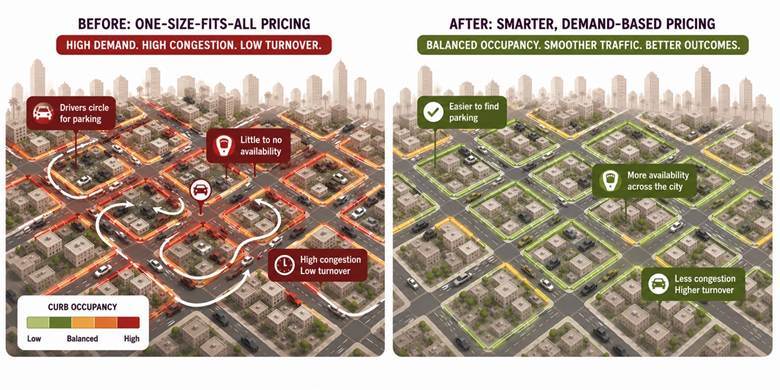
Congestion reduction is not a side effect of good parking management. It is one of the primary things good parking management does.
Keep Asking Questions until you Have a Program Worth Running. Then Ask Some More.
The aspirational program described at the outset of this piece is not a vision. It is an engineering problem — a question of what inputs, managed well, produce the outcomes that justify the program's existence.
Those outcomes are achievable. Cities don't need new technology, new legislation, or new staff. They need someone willing to ask the questions the accumulated program was never designed to answer, and to use the data that has been sitting in these systems all along.
At Trellint, that is the work we show up to do. And for the people doing it — the directors, the analysts, the enforcement ambassadors — we'd offer this: the outcomes you produce are not abstract. They belong to the city you live in.
When enforcement gets fairer, when streets get safer, when a loading zone finally works the way it's supposed to — that's not just a metric on a dashboard. That's the city outside your window. That is worth measuring and being proud of.
If you would like to have a further conversation about this topic, please contact us here.
Read the newest updates and insights from our team.
As parking technology matures, feature lists matter less than architecture. Here's what agencies should really evaluate when choosing their next platform.

As AI adoption grows across the parking industry, Gaurav Khanna from Trellint explores why success depends on building an AI-ready organization.

Discover key takeaways from Trellint's IPMI Virtual Learning Lab, where David Strathy-Miller and Sean Mackin discuss open ecosystems, modernization, and future-ready parking technology.

Evaluate parking citation collections bids with confidence. A practical guide to RFP requirements, vendor accountability, performance oversight, and revenue recovery.
Discover how predictive modeling, forecasting, and independent analysis help cities improve parking collections performance and revenue outcomes.
Discover how to manage a flexible, integrated ecosystem that delivers safer streets, better mobility, and long-term value.
Have a question or request? Let us know and we’ll follow up shortly.